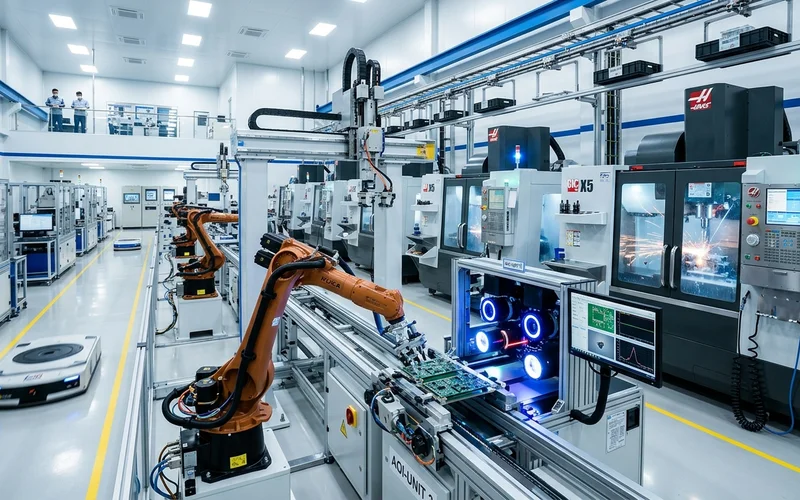
The global manufacturing landscape has undergone a digital revolution. While manual G-code programming at the machine controller remains an essential troubleshooting skill for simple parts, modern aerospace brackets, injection mold cavities, automotive engine blocks, and orthopedic implants cannot be programmed by hand. They require powerful Computer-Aided Design (CAD) and Computer-Aided Manufacturing (CAM) software suites like Mastercam and SolidWorks.
The CNC Career Ladder: Operator vs. Setter vs. CAM Programmer
In precision machining facilities across India and the GCC (UAE, Saudi Arabia, Qatar, Oman), clear wage tiers and job responsibilities exist:
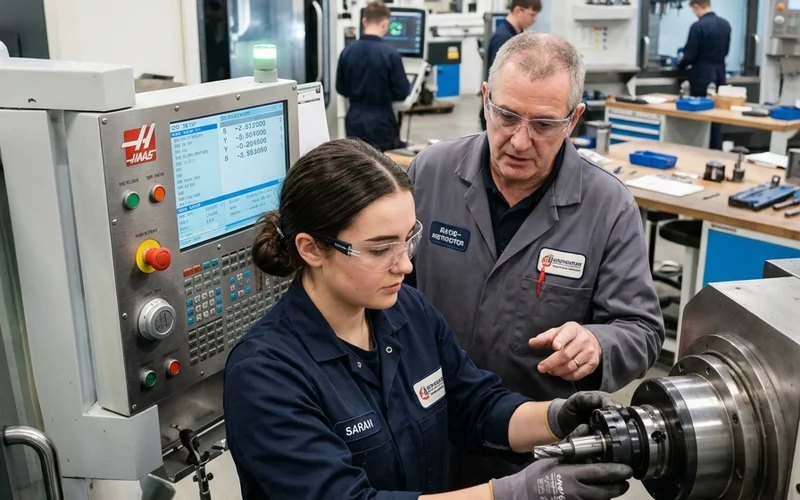
- CNC Operator: Responsible for loading billets into pneumatic chucks/vises, pressing cycle start, clearing chips, and performing go/no-go gauge checks.
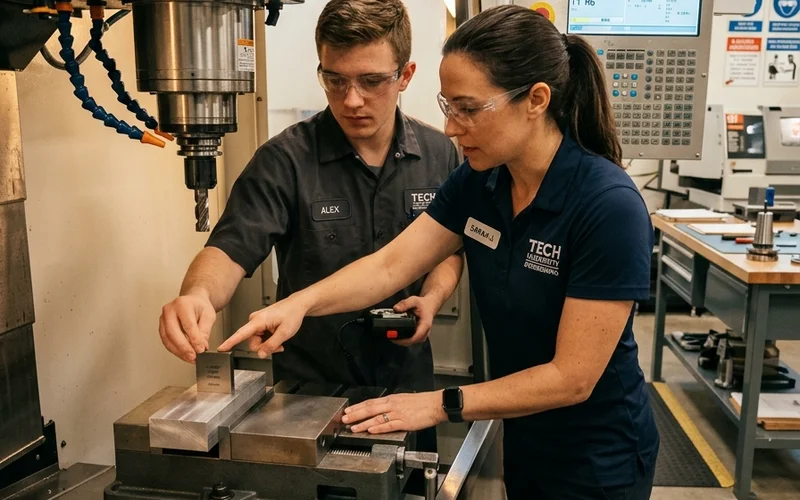
- Setup Machinist / Setter: Indicates fixtures, sets Work Coordinate System origins (G54–G59), dials in tool length and wear offsets, performs First Article Inspection (FAI), and proves out new programs.
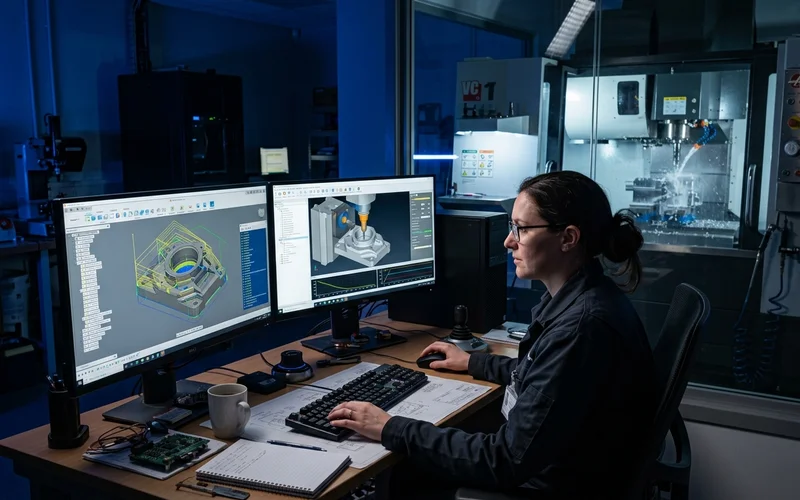
- CNC Programmer / CAD/CAM Engineer: Analyzes customer 3D CAD models, designs specialized workholding fixtures, selects cutting tools and insert geometries, programs high-speed dynamic toolpaths, verifies collision safety in 3D simulation, and outputs controller-specific G-code.
Moving from an operator role to a certified Mastercam CAD/CAM programmer typically doubles or triples earning potential, moving you from the hot shop floor into the air-conditioned engineering design and production planning office.
High-Demand CAD/CAM Competencies Sought by Employers
1. High-Efficiency Dynamic Milling (Dynamic Motion)
Traditional milling toolpaths bury cutting tools in corners, leading to cutter spikes, tool breakage, and sluggish cycle times. Modern Mastercam Dynamic Motion toolpaths maintain a constant radial tool engagement angle, enabling full axial flute depth cuts at ultra-high feed rates, slashing cycle times by up to 70% and multiplying tool life.
2. Complex 3D Surface Contouring
Mastering 3D surface finish strategies—such as Equal Scallop, Waterline, Raster, and Pencil rest-milling—allows programmers to machine complex automotive molds and aerospace aerodynamic surfaces with mirror-like surface roughness (Ra < 0.4 µm) without requiring manual polishing.
3. Collision Detection & Digital Twin Simulation
Scrapping a multi-lakh rupee titanium billet or damaging a precision CNC spindle due to tool holder interference is catastrophic. CAD/CAM software allows engineers to simulate the entire machine envelope—including vises, clamps, tool shanks, and rapid traverse clearance planes—with 100% gouge-free confidence before posting code.
4. Controller-Specific Post-Processing
A flawless CAM toolpath is only as good as the machine-specific G-code it generates. Skilled programmers know how to configure and modify post-processors for Fanuc, Siemens Sinumerik, Haas, and Heidenhain controllers, ensuring seamless M-code handshakes, through-spindle coolant activation, and safe tool-change macros.
The Winning Formula: Machine Practice + Mastercam CAD/CAM
The most respected and highest-paid CAM programmers are not pure software theorists—they are professionals who possess hands-on shop floor experience. When you combine physical intuition for cutting speeds, chip control, and workholding rigidity with advanced Mastercam software proficiency, you become an indispensable asset to any precision engineering enterprise worldwide.
At LENOCAM Academy in Manjeri, Kerala, our CAD/CAM Software Training program bridges this exact gap, pairing high-end software workstations with live VMC machine spindle execution.
Practical CNC training, technical insights, and precision manufacturing knowledge from LENOCAM Academy in Manjeri, Kerala.