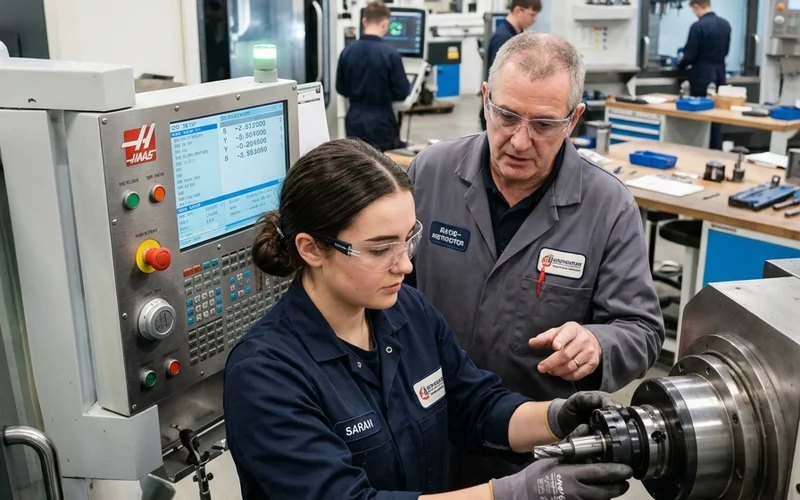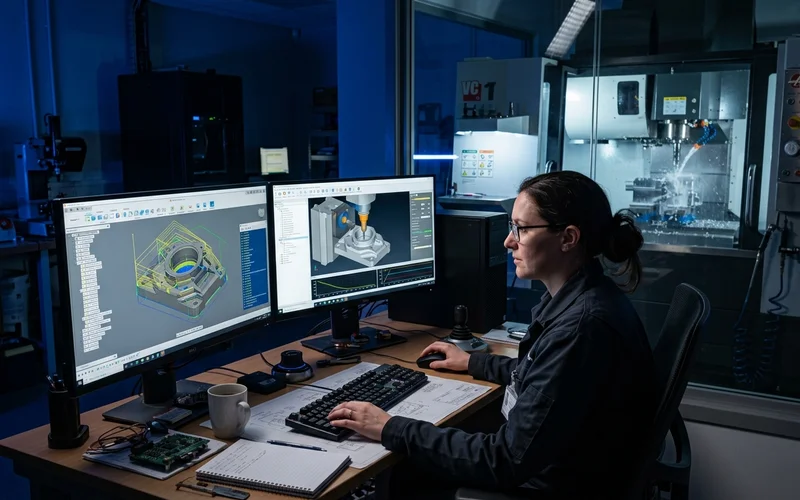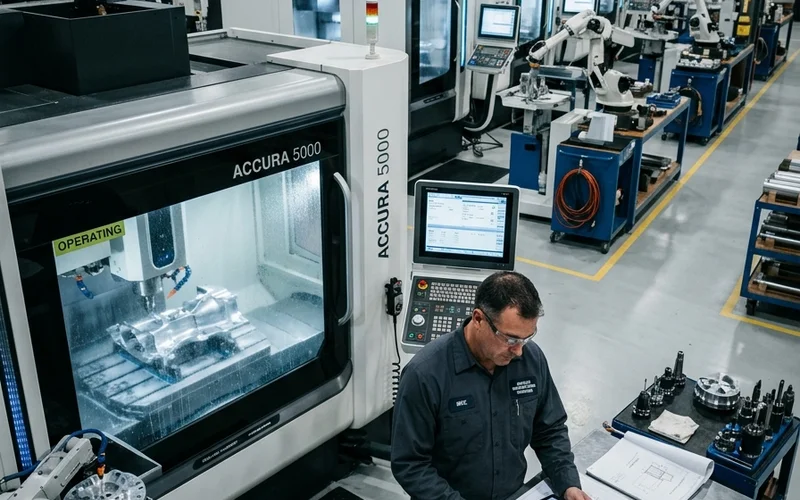
Securing your first role as a certified CNC operator, VMC setup technician, or junior CAD/CAM programmer is a major milestone. Precision engineering companies across aerospace, automotive, medical device manufacturing, and oil & gas sectors in India (Bangalore, Chennai, Pune, Coimbatore) and the GCC (Dubai, Abu Dhabi, Dammam, Doha) are actively seeking disciplined technicians who demonstrate hands-on competence, safety reflexes, and blueprint literacy.
To help you stand out from the competition, our senior instructors at LENOCAM Academy have compiled the essential preparation checklist for cracking technical interviews and hands-on shop floor machine tests.
The 4 Stages of a Modern CNC Technical Interview
1. The Engineering Blueprint & GD&T Test
In almost every technical screening, interviewers hand candidates a production engineering drawing and ask them to explain:
- Datum Reference Frames: Identify primary (A), secondary (B), and tertiary (C) datums and explain how the part must be located in a machine vise.
- Tolerances: Differentiate between bilateral tolerances (e.g.,
50.00 ± 0.02 mm) and limit dimensions (49.98 / 50.02 mm). - GD&T Symbols: Explain True Position (
⌖), Perpendicularity (⊥), Flatness (⏥), and Maximum Material Condition (Ⓜ).
2. The Precision Metrology Practical Test
Employers will ask you to measure sample components right in front of them to evaluate your instrument handling:
- Micrometer Technique: Zeroing the ratchet stop, feeling the gentle friction of the spindle face against the workpiece, reading the thimble and vernier scale to 0.001mm (1 micron).
- Bore Gauge Setting: Setting an internal bore gauge with a micrometer reference ring and sweeping across the diameter to locate true minimum/maximum.
- Height Gauge & Granite Plate: Zeroing a digital height gauge against slip gauge blocks and taking step measurements.
3. The G-Code & Canned Cycle Written / Oral Test
Expect direct technical questions regarding manual ISO programming syntax:
- Coordinate Systems: Explain the difference between Machine Coordinate System (G53), Work Coordinate Systems (G54–G59), and Incremental (G91) vs. Absolute (G90) positioning.
- Canned Cycles: Explain G81 (Standard Drilling), G83 (Deep Hole Peck Drilling with Q-depth), G84 (Rigid Tapping), G71 (Lathe Stock Removal), and G76 (Lathe Threading).
- Cutter Compensation: Explain why
G41(Cutter Compensation Left) is used with climb milling and how lead-in/lead-out vectors prevent gouging part contours.
4. The Live Shop-Floor Machine Test
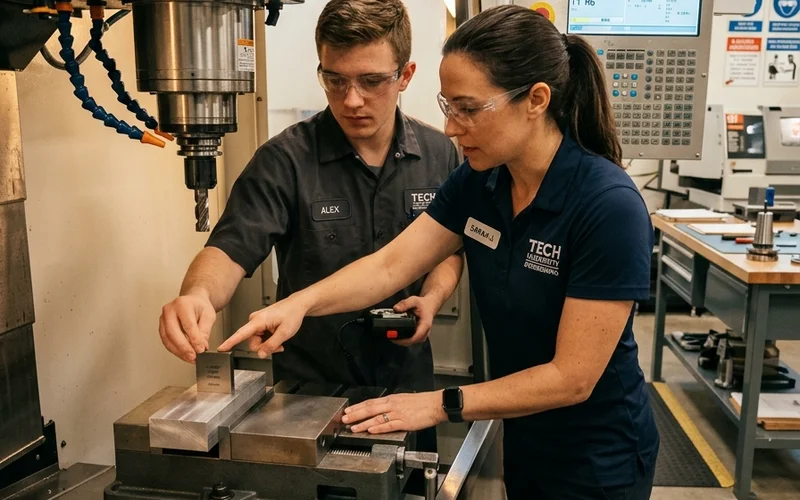
For higher-tier setup and operator roles, companies will take you to an actual VMC or CNC lathe on the shop floor:
- You will be asked to mount a vise, tram it to within 0.01mm using a dial indicator, and clamp a raw stock billet.
- You will set the X/Y datum with an edge finder or touch probe and input the coordinates into
G54. - You will touch off a tool to set the tool length offset (
H01) and run a single-block dry run with feed rate override at 20%.
Golden Rules for Your First Month on the Shop Floor
- Never Guess — Always Ask: In a CNC machine shop, asking your supervisor or senior programmer a clarifying question takes 30 seconds. Crashing a 12,000 RPM ceramic bearing spindle or destroying a custom carbide tool costs thousands of dollars and damages your reputation.
- Carry a Shop Pocket Notebook: Write down specific setup quirks, tool holder extensions, preferred feeds and speeds for stainless steel 316 vs. aluminum 6061-T6, and controller alarm reset routines.
- Master Personal Safety (PPE): Never wear gloves, rings, watches, or loose sleeves around rotating spindles. Always wear ANSI-certified safety glasses with side shields and steel-toed boots.
At LENOCAM Academy in Manjeri, Kerala, our curriculum includes mock technical interviews, timed machine tests, and blueprint assessments, ensuring our graduates enter the job market with 100% confidence and industry readiness.
Practical CNC training, technical insights, and precision manufacturing knowledge from LENOCAM Academy in Manjeri, Kerala.